James DENT
1782-1837
Convict reinterred at Woronora
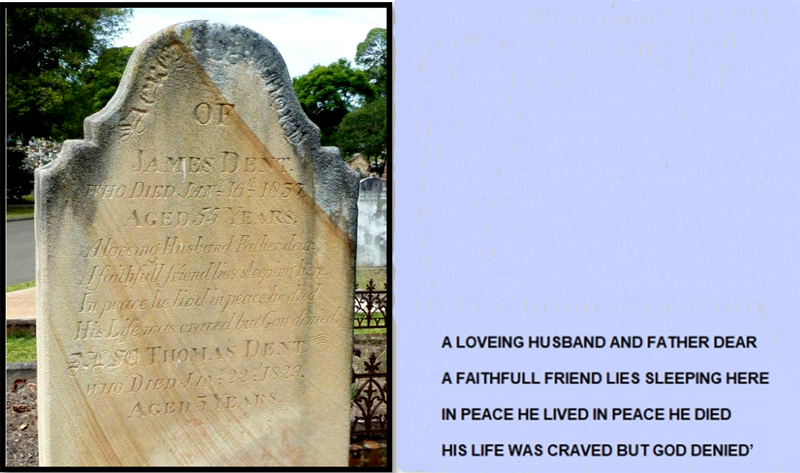
The
photo above was taken in 2019. The touching verse engraved on this tall,
rounded memorial cut from Sydney sandstone marks a single grave in the
Anglican section of Woronora Cemetery.[i]
It indicates the final resting place of James
Dent
who died
16 January 1837 aged 55. Another
inscription on this headstone reads ‘Thomas Dent who died Jany 22nd 1829
aged 3 years’. The existence of this headstone in
Woronora
Cemetery
is a mystery because it predates when the cemetery was gazetted as a
General
Cemetery,
for the use of all denominations, on
2 April 1895.[2]
About five kilometres from the cemetery is Dents Creek where an attempt to
harvest the underlying coal seams was made in the late 1880s.
Fred
Dent
was said to be in charge of this venture at some point which is how the
creek got its name.[3]
Is there a connection between Fred Dent and the Dent memorial?
By 1820 a new Sydney burial ground was
required when the George Street burial site, now under the Sydney Town Hall,
became overcrowded and a health risk. Devonshire
Street
General
Cemetery
was consecrated in 1820 and provided for burials in denominational areas. In
the summer of 1829, three year old
Thomas, son of James and
Elizabeth
Dent,
died at
Cooks River.
His burial was recorded in the parish register of St James, Sydney and he
was laid to rest in the Anglican section of Devonshire Street Cemetery.
Thomas’ father, James Dent died in 1837, and was buried with his little boy.
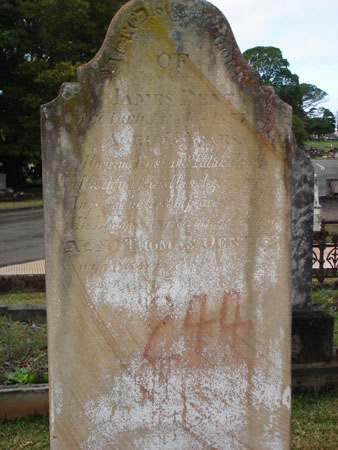
The photo below, taken in 2008, shows the three large faded red numbers, 244
indicating the plot number.
[4]
 Twenty one
years earlier at the Middlesex Gaol Delivery, 33 year old
James
Dent
was charged with ‘having forged bank notes etc’.[5]
A butcher by trade from
Essex, he was found guilty on
14
February 1816 and sentenced to 14 years
transportation. James sailed from
Spithead on board the transport ship
Elizabeth on
4 June 1816,
one of 155 male convicts bound for Port Jackson. Built in 1809 this was the
Elizabeth’s
first of a number of voyages fitted out as a convict ship.[6]
Also on board the vessel were the new Judge Advocate John Wylde and his
extended family.
Twenty one
years earlier at the Middlesex Gaol Delivery, 33 year old
James
Dent
was charged with ‘having forged bank notes etc’.[5]
A butcher by trade from
Essex, he was found guilty on
14
February 1816 and sentenced to 14 years
transportation. James sailed from
Spithead on board the transport ship
Elizabeth on
4 June 1816,
one of 155 male convicts bound for Port Jackson. Built in 1809 this was the
Elizabeth’s
first of a number of voyages fitted out as a convict ship.[6]
Also on board the vessel were the new Judge Advocate John Wylde and his
extended family.
About 1819, James petitioned Governor
Lachlan Macquarie for a conditional pardon. In the letter, he stated that he
acted as a servant in the cabin of the Judge Advocate,
John
Wylde
for the entire voyage of the
Elizabeth
and that he had continued to serve the Judge since his arrival. Although the
1822 muster shows the letters CP next to his name, indicating
James
Dent
had received a conditional pardon, there is no other documented evidence to
support this claim. On the letter to the Governor, the large pencilled
letters TL in the margin indicate a Ticket of Leave was also granted.[7]
The year after he petitioned the
Governor, 37 year old
James
Dent
married Elizabeth
Hood
on 14
May 1820 in the newly built St Lukes Church of
England at Liverpool.[8]
The location of this marriage is puzzling as all of the early events found,
relating to this family, took place in the Sydney or Petersham area.
Perhaps Elizabeth
was located in Liverpool
before her marriage or maybe she just liked the new church. Elizabeth’s
origins are unknown. The 1828 census shows that she was 24 years old when
she arrived in the colony on the Elizabeth,
the same ship on which her husband arrived, although she was not a guest of
the British government. Could Elizabeth
have also been in the employ of
John
Wylde
who was travelling with his wife, children and father? Was she the nursemaid
to Mrs
Macquarie
as suggested in the biography of the Dent’s eldest son
George?[9]
James and Elizabeth had four children,
George
Richard,
Sarah,
Thomas,
and Henry.
The Dents lived in Sydney
in the first years of their married life and
George was born in
Hunter Street.[i0]
He was baptised at
St Phillips
church as was his sister Sarah.[ii]
On 21
February 1829, before his third birthday on 22
April, Thomas was baptised at
St James
church. The reason for the late baptism could be that although the Dents
were at Cooks
River
when Thomas
was born, the journey to the nearest church was too difficult.
St Peters at
Cooks
River,
whose registers begin in 1838, had not been built.
Perhaps Thomas had an accident or was
very ill as he was baptised just three days before he was laid to rest in
Devonshire
Street
Cemetery.
Henry was also baptised at
St
James
church in Sydney.
The 1828 census records James as a landholder of 30
acres at Petersham. With him are his wife and children
George aged 7,
Sarah aged 5 and ‘John’ aged 1½.[12]
Of his 30 acres, twelve had been cleared with two horses and four horned
cattle on the property. None of the property was under cultivation although
in the following years, 1829 and 1830 when Thomas and
Henry were baptised,
James’ occupation was shown as
farmer.
James
applied for permission to bid for land with a view to purchase in June 1830.
The land was described as 80 acres, a swamp in the district of Bulanaming
bound on the west and north by
James
Moor,
on the north by
Edward
Langton
and on the east by James
Wain.[13]
He was leasing
James
Waine’s
farm at this time.
James
Waine,
was convicted to seven years transportation at Northampton Assizes. He
arrived on the Scarborough
in November 1789 and was granted 30 acres in September 1795 as a reward for
good behaviour.[14]
The swamp was
Gumbramorra
Swamp,
fed by a creek from the west to become the head of Gumbramorra Creek which
drained into
Cooks
River
at Tempe. By the 1840s
people were living on both sides of the swamp and a track was formed to
cross it. This track became Sydenham Road.[15]
A map showing Waine’s Farm and
Gumbramorra
Swamp
can be found in
Richard
Cashman
and Chrys Meader’s book,
Marrickville: Rural Outpost to Inner City.
On 24 August 1831,
James
drew up a will. In it, he declared he was living at Waines Farm near
Cooks
River
and bequeathed a brown mare in foal, a muse-coloured filly, three heifers,
two working bullocks, a cart and harness, and a fowling piece to his son
George who was then nine
years old. He requested ‘that
Mrs
Shaughnessy
will take my son
George
Dent
her God Son with the articles specified in this
Will and Apprentice him to the
Cabinet Business’.[16]
James
died on
17 January 1837, six years after making
his will. It is not known if his request regarding
George’s apprenticeship was carried
out. George
was 15 when his father died and it was at this time that he ‘left Sydney
and went bush to become a sawyer’.
George later became a shipbuilder
of note, the founder of the industry at Jervis
Bay
in the early 1860s. He owned land at Huskisson right on the Bay where his
shipyard and sawmill were located. Steamers, schooners and many smaller
craft were built here.[17]
Today the site is close to the
Lady
Denman
Museum
where the ferry of that name, built by
George’s son Joseph, can be found restored
and on public display.
Henry was seven years old when his father
died. He was a sawyer all his working life and possibly worked with his
brother during the 1840s supplying timber for the Sugarworks on
Cooks
River.
One month short
of her 17th birthday, Sarah Dent married Isaac Parkes on 4 January 1841 at
St Peters, Cooks River witnessed by her brother George. Two months
previously, George had married Isaac’s sister Elizabeth Parkes. Isaac and
Elizabeth were children of John and Margaret Parkes who had settled at
‘Parkes Camp’ later known as Earlwood.[18]
The two couples continued to live in the Cooks
River
area, Isaac
and George
recorded as sawyers in the parish register of St Peters, when each
of their children was baptised during the 1840s and 1850s.
In 1901 Devonshire Street
Cemetery was resumed for the extension of the railway terminus and the
creation of Central station. It had been closed for new burials since 1867.
Relatives of the deceased interred in the cemetery could obtain exhumation
permits to move the remains of loved ones to other cemeteries
established in the
broader Sydney
area. Sarah Parkes, the only daughter of James Dent obtained a permit to
exhume her father’s and little brother’s remains. What were the choices?
Sarah’s
mother died in 1858 on 13 August and she was buried in the churchyard of
St Peters
Cooks
River.[19]
Buried in the same grave are the two wives of George Dent, Elizabeth nee
Parkes who died in 1866 and Harriet nee Arundell who died in 1887. The last
burial in this churchyard was 1896 so reinterment could not take place
there.
In 1901, Sarah’s address was Forest Road,
Bexley a reasonable distance to
Woronora General
Cemetery
which was six years young.
Rookwood
Cemetery
was also an option. Sarah
was 77 years old, perhaps she considered where her final resting place would
be when she chose Woronora for the reinterments.
Henry
Dent,
in his twilight years retired to
Wollongong and lived in a
‘pretty villa…situated in a good position and command[ing] a fine view of
the Pacific Ocean’.[20]
When he died on 22 September 1905 at the
age of 76, he was buried with his father and little brother in
Woronora
Cemetery.
Sarah Parkes died 12 November 1912 and was buried in the Methodist section
of the cemetery.
Finally, the
connection to Dents Creek is not proven but
James
Dent
did have a grandson Frederick
Charles
born in 1860 and great grandsons
Frederick
Dent
and
Alfred Dent
born 1870 and 1871. Could one of them have been
Fred
Dent
who drilled for coal in the late 1880s?
Sue Hewitt
First published in The Endeavour
September 2008,
Revised 2019.
Resources:
[1] Anglican section H grave 94.
[2] Michael
Bond,
Woronora
Cemetery and Crematorium
Sutherland 1895-1995.
[AN.SOU.5.2232.2]
[3]
Sutherland Shire Historical Society,
Bulletin Nov 1977 p103.
[4] The
faded red numbers on the headstone would seem to relate to the plot
number. Johnson and Sainty, Sydney
Burial Ground1819-1901.[AN.SOU5.2000.1]
[5] The
National Archives, PRO Reel 2735. Trials at Middlesex Gaol Delivery can
be found at
www.oldbaileyonline.org. However, the trial report of
James
Dent remains elusive.
[6] Charles
Bateson,
The Convict Ships1787-1868.
[G.CONV.HIS.1]
[7] This
correspondence is undated though it is bundled with other correspondence
dated 1819. Although a ticket of leave number 2110 was found, the butt
(the copy kept by the government) does not survive. The 1828 census
records that James had a ticket of leave.
[8] NSW
BMD 1820 Vol 3A entry 2544. This is a chronological list of all
marriages in a number of parishes.
[9]
Shoalhaven pre 1900 Pioneer Register Vol 1.
[G.BIOG.4N.2a]
[11] George
Richard
baptised
28 July 1822,
Sarah baptised
11 April 1824, NSW BMD Vol 1B entry
5919 and 6539.
[12] This
is most likely Thomas who was
born on 22 April 1826.
Census of NSW November 1828.
[AN.SOU.6.7]
[13] State
Records NSW: Colonial Secretary’s Correspondence re Land, James
Dent
1830, 2/7841 Reel 1119. Bulanaming is an aboriginal name which describes
the present day local government area of Marrickville, including
Petersham.
[14] Michael
Flynn,
Britain’s Grim Convict Armada of 1790,
The Second Fleet.
[G.CONV.BIOG.5]
[16]
SRNSW: NRS 13660, Series 1 Item 964.
[17]
Shoalhaven pre 1900 Pioneer Register Vol 1.
[G.BIOG.4N.2a]
[18] Brian
Madden & Lesley Muir,
Earlwood’s Past.
[AN.LH.2206.1]
[19] Laurel
Horton,
Grave Reflections, the
Story of
St Peters
Graveyard Cooks
River.
[AN.SOU.5.2044.1]
Elizabeth
Dent married Malachi English in
1839 and then married
Richard
Page in 1842.
[20]
Australian Men of Mark
Vol 2, version 6.