
Robert RITCHIE 1770-1849
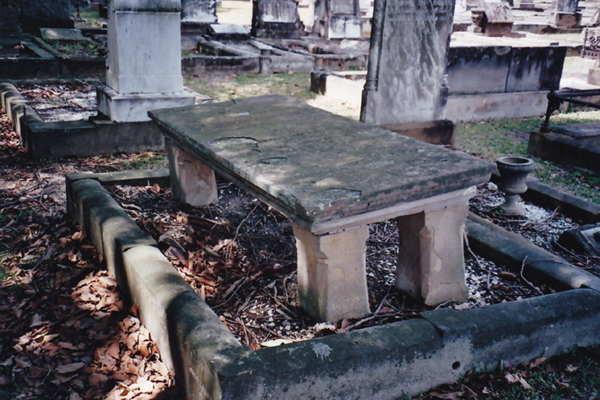
Within Woronora Cemetery, a memorial stone marking
the death of Robert Ritchie and his wife Ann can be found in the Presbyterian
section.[i]
The dark grey stone supported by four short sandstone pillars resembles a
tabletop placed over a double grave surrounded by a concrete border. Usually a
tabletop tomb or vault has enclosed sides but not in this case. The inscription,
now 170 years old and much eroded, reads:
Sacred/ to the Memory of/ Robert Ritchie/ who departed this
life/ at the Nepean River/
19th of November 1849/ aged 89 years.[ii]
Also/ his wife Ann Ritchie/ who died 1 January
1865/ age 68 years.
Woronora Cemetery is a long way from the Nepean
River. How did this headstone, recording two deaths that predate the cemetery’s
first burial in 1895, find its way to Woronora Cemetery in Sutherland?
Robert Ritchie’s will
dated 14 September 1848, details his property holdings on the Nepean River at
Castlereagh. His farms were known as Chessers, Grose Farm and Hobby’s Farm plus
another unnamed farm of 560 acres bought from Alfred Stephen Esq. In Sydney, he
owned property fronting Pitt and Park Streets and also in Castlereagh Street and
Exeter Place. The will indicates that he may have owned other unspecified
property which he left for the benefit of his wife Ann. Other beneficiaries in
the will include some of Ann’s relatives and Ritchie’s son James Ritchie on the
condition that he remained in New South Wales.[iii]
Ann Ritchie nee
Kennedy also left a will which included detailed descriptions of her numerous
properties on the Nepean and in Sydney. All the beneficiaries were Kennedy
family members. Ann states that her late husband Robert Ritchie was buried in
the Presbyterian burial ground which formed part of what later became known as
Devonshire Street Cemetery in Sydney. Ann directed her executors to distribute
£100 to the trustees of this burial ground to invest and use the interest earned
on the investment for the upkeep of her husband’s tomb. Ann also directed that
her remains be placed in the tomb. Robert Ritchie held a trustee positon for the
Pitt Street Presbyterian church in 1842. The tombstone inscription suggests
Ritchie was visiting one of his Nepean properties when he died.
Robert
Ritchie or Richey was a native of Killyleagh in County Down, Northern Ireland.[iv]
In his early 20s, after being caught for stealing an ox, he was convicted of the
crime at Downpatrick Assizes in April 1800 and subsequently sentenced to
transportation ‘beyond the seas’ for his lifetime. Incarcerated in Ireland for
19 months, he then endured a seven-month voyage on board the
Hercules which sailed into Port Jackson on 26 June 1802.[v]
The Hercules
deposited 165 Irish convict men and women for government assignment in Sydney
Town and outlying areas. However, Governor King was of the opinion that the
convicts ‘were in a state of convalescence… too weak and debilitated to be ever
of much use.’[vi]
Ritchie was 25 years old.
While
still a convict, Ritchie’s movements in the colony can be traced in the musters
and the 1828 census. At first he rented land in the Hawkesbury district, farmed
the land and kept hogs. On 6 August 1810, the government granted Ritchie his
ticket of leave, allowing him to seek employment within the district of
Hawkesbury.[vii]
He could not leave this district unless authorised to do so by the presiding
district magistrate. However by 1815, he had settled in Castlereagh.
On
New Year’s Day 1816, Ritchie married Ann Kennedy, a currency lass and daughter
of Donald also known as Daniel Kennedy. Ritchie and a much younger Ann, repeated
their vows before the Presbyterian Reverend Henry Fulton in the parsonage at
Castlereagh. Four weeks after the wedding, Ritchie received a pardon on
condition that he did not leave New South Wales. At this time he is a landholder
at Castlereagh[viii]
but whether he owned land prior to his marriage or acquired it after he married
Ann is not known.
Ann Ritchie died on
1 January 1865 at her home located at 343 Pitt Street, Sydney. Thirty-six years
after her death, preparations to extend Sydney’s railway terminus northward was
underway and would incorporate the land dedicated to the Sydney Burial Ground or
Devonshire Street Cemetery. Relatives of the deceased were given the opportunity
to arrange for the removal and reinterment of their loved ones to other Sydney
cemeteries.
Ann’s niece and one
of the executors of Ann’s will, Mrs Ann Elizabeth Sproule, nee Howell was
granted an exhumation permit for her aunt and her uncle Robert Ritchie. Mrs
Sproule’s husband, John Sproule was the Presbyterian trustee for the Sutherland
cemetery and arranged for his wife’s relatives to be reinterred at Woronora.
John
Sproule also arranged for the exhumation and reinterment in Woronora Cemetery of
his first wife, Mary Ann Sproule who died on 19 August 1865 and their infant
children Emma Jane and William John. No headstone marks the site of their
reinterment.[ix]
Sue Hewitt 2019
References:
[i]
Presbyterian Section C graves 79 and 80.
[ii]
Robert’s age varies according to the record consulted: 25 in 1802
(convict indent); 80 in death notice (SMH 24 November 1849 p.2); 89 on
his headstone.
[iii]
James Ritchie died on 16 December 1883 at Mount Ritchie, Castlereagh,
Nepean River (SMH 31 December 1883 p.1) aged 88 suggesting that James
was born prior to his father’s arrival in the colony.
[iv]
Williams, Noelene (comp.)
Down to New South Wales:
my Irish rogues, convicts of County Down, 1999.
[v]
The Hercules
left Ireland on 29 November 1801 and arrived in Port Jackson on 26 June
1802.
[vi]
HRNSW Vol. 4 Governor King to Lord Hobart, 17 September 1802.
[vii]
SRNSW NRS1166 Register of Tickets of Leave 1810-1814.
[viii]
SRNSW NRS898 Colonial Secretary’s Special Bundles 1794-1825.
[ix]
Johnson, Keith A and Sainty, Malcolm R
Sydney Burial Ground
1819-1901.